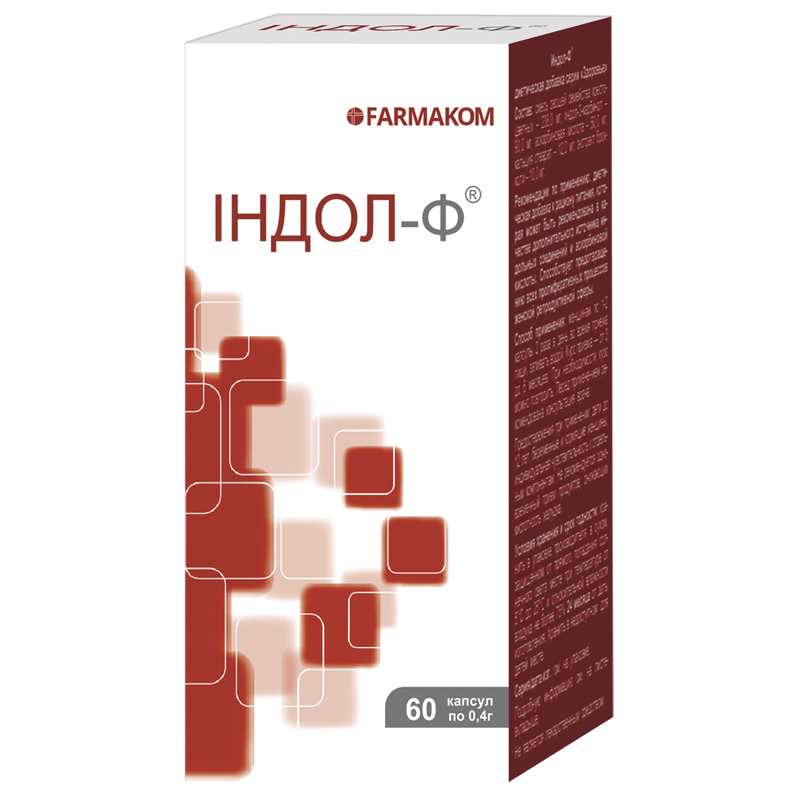
INDICATIONS FOR USE Dietary supplement to the diet – an additional source of indole compounds and ascorbic acid.
COMPOSITION Mixture of cruciferous vegetables – 59.5% (238.0 mg), indole-3-carbinol – 22.5% (90.0 mg), antioxidant ascorbic acid – 12.5% (50.0 mg), calcium stearate – 3.0%, broccoli extract – 2.5% (10.0 mg).
METHOD OF APPLICATION Children from 12 years and adults 1-2 capsules 2 times a day during or after meals, drinking plenty of water. The recommended course of consumption is from 3 to 6 months.
PRECAUTIONS FOR USE Age up to 12 years, pregnancy, breastfeeding, individual sensitivity to components. It is not recommended to take foods that reduce stomach acid at the same time.
KCAL / 100 G ENERGY VALUE 89 kcal
FOOD (NUTRITIONAL) VALUE OF 100 G PRODUCT Proteins – 1.8 g, carbohydrates – 0,68 g, fats – 0,2 g.
ISSUE FORM 400 mg capsules.
SHELF LIFE 24 months
ADDITIONAL INFORMATION
Experience of using the dietary supplement Indole-F® in women with the presence of human papillomavirus of high carcinogenic risk in the epithelium of the cervix – M.V. Medvedev, Yu.V. Donskaya, Dnepropetrovsk Medical Academy, Dnepr // WOMEN’S HEALTH, No. 8 (134) / 2018, pp. 1-5
Modern approaches to the treatment of endometrioid ovarian cysts – O. S. Shapoval, PhD, Associate Professor of the Department of Obstetrics and Gynecology, State Institution “Zaporizhzhya Medical Academy of Postgraduate Education of the Ministry of Health of Ukraine” // Medical aspects of women’s health No. 8 (105) ‘2016, pp. 2-8
Evaluation of the effectiveness of the drug Indol-F in patients of reproductive age with breast dysplasia – S. A. Lasachko, PhD, Associate Professor of the Department of Obstetrics, Gynecology and Perinatology, UNIPO, Donetsk National Medical University named after Maxim Gorky, Head of the Department of Diagnostics and Treatment of Breast Diseases, Donetsk Regional Center for Maternal and Child Health // Medical Aspects of Women’s Health, No. 7 (104) 2016, pp. 2-8
Smoking and reproductive health disorders are the main risk factors for MRD in women of reproductive age – S. A. Lasachko, PhD, Associate Professor of the Department of Obstetrics, Gynecology and Perinatology of the Maxim Gorky Donetsk National Medical University, Head of the Department of Diagnostics and Treatment of Breast Diseases of the Donetsk Regional Center for Maternal and Child Health // Medical Aspects of Women’s Health No. 2 (98) ‘2016, pp. 2-9
Clinical and hormonal characteristics and therapy of girls with endometrial hyperplasia against the background of anemia – Prof. I. A. TUCHKINA, Zh. O. GILENKO, Ph.D. N. N. V. KALASHNIK, Ph.D. L. L. A. VYGOVSKAYA, Kharkiv National Medical University // INTERNATIONAL MEDICAL JOURNAL, 2014, No. 3, pp. 87-91
Modern aspects of complex therapy of recurrent papillomavirus infection – I.A. Yu. Kuzmina1, O.I. Kalinovskaya1, O.A. Kuzmina1, V.A. Fedorchenko2, 1 – Kharkiv National Medical University, 2 – State Health Institution “Kharkiv Regional Clinical Perinatal Center”// International Medical Journal, 2014, No. 1, pp. 51-56
Non-hormonal therapy of proliferative processes of the mammary gland and endometrium – N.M. Voloshina, S.M. Pashchenko, N.F. Shchurov, Zh.M. Makarova, A.P. Pauk, Zaporizhzhya Medical Academy of Postgraduate Education // WOMEN’S HEALTH No. 1 (77) / 2012
Non-hormonal pathogenetically based therapy of uterine fibroids – V. M. Astakhov, Donetsk National Medical University named after M. Gorky // WOMEN’S HEALTH №3 (59)/2011